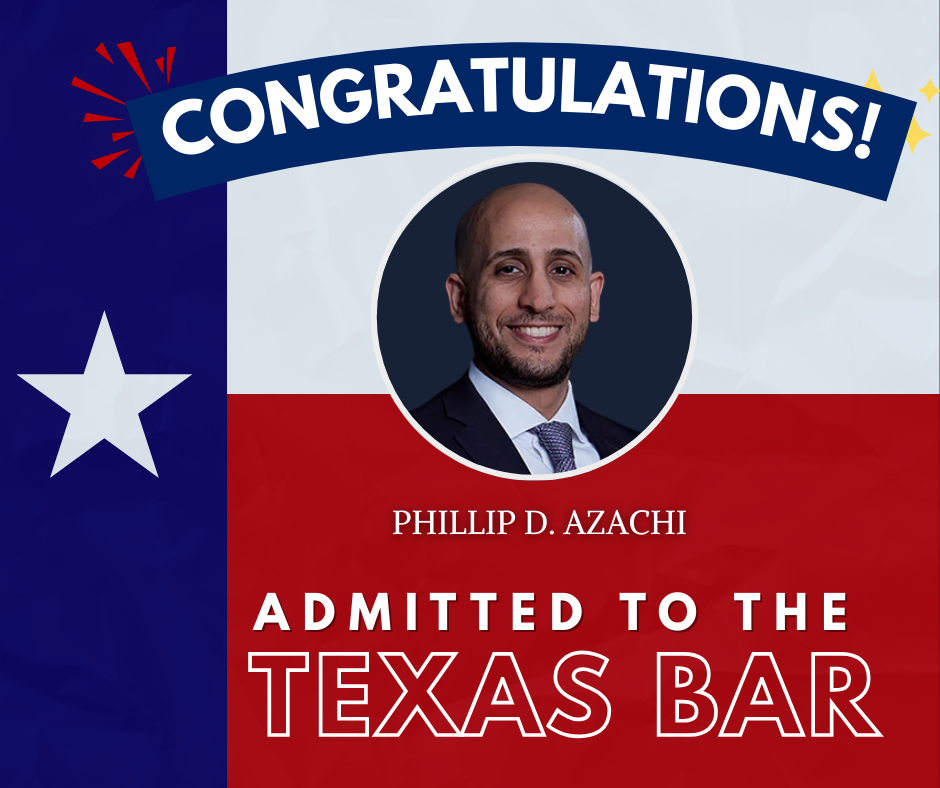
Plano, TX business owners and individuals can now benefit from local counsel with legal experience rooted in multiple jurisdictions. Phillip D. Azachi, partner at DeCandido & Azachi, PLLC, has recently been formally admitted to the Texas Bar, expanding the firm’s ability to serve clients in Collin County, Dallas‑Fort Worth, and beyond.
What Does Admission to the Texas Bar Mean?
- Legal authority in Texas: Only licensed Texas attorneys can represent clients in state courts, advocate in front of state agencies, or draft binding legal documents while practicing law in Texas.
- Ethical accountability & professionalism: State bar admission reflects a lawyer’s dedication to upholding Texas Rules of Professional Conduct.
- Local insight & credibility: An admitted Texas attorney understands state- and county-level statutes, regulations, and best practices.
As of his admission, Phillip D. Azachi can now provide direct representation in Dallas County, Collin County, and Plano, TX.
Read more about Phillip D. Azachi
Phillip D. Azachi: A Multistate Advocate Now Admitted in Texas
Phillip Azachi, previously licensed in New York, has long coordinated legal matters involving business law and commercial litigation. Now, with official Texas Bar admission, he serves local Plano clients directly in:
- Contract drafting & review for Plano businesses
- Business financing strategy, mergers, acquisitions, and succession planning in Collin County and Dallas‑Fort Worth
Learn more about business financing strategies - Estate planning, trusts, and probate tailored for Texas families and business owners
Explore our estate and trust services
Why Bar Admission Is Critical for Plano Clients
Valid Legal Representation in Plano, TX
Bar admission ensures clients receive legally valid and enforceable advice backed by state mandates and court authority.
Familiarity with Texas Law and Local Courts
From the Plano municipal courts to Collin County district courts, only attorneys admitted in Texas can properly represent clients.
Security & Trust
Bar admission includes background checks, continuing legal education, and adherence to ethical standards protecting clients in case handling.
How DeCandido & Azachi Serves Plano Clients Post‑Admission
Business Law & Contract Services in Plano, TX
Phillip and the team now deliver legal guidance on corporate formation, contract drafting, and asset protection directly in Plano and surrounding areas.
Explore our Texas business law services
Business Financing & Succession Planning
Local startups and legacy businesses can lean on Texas-bar admitted counsel for financing strategies, investment structuring, and exit planning.
Learn more about business financing
Estate Planning & Trusts
With Texas admission, the firm now offers wills, trusts, and probate services tailored under Texas law.
View estate planning options
Work with a Texas‑Bar Admitted Attorney in Plano
For business owners, families, and individuals in Plano and Collin County seeking legal representation from a fully licensed Texas attorney:
Contact DeCandido & Azachi in Plano, TX at 972‑882‑6600 or visit the Texas Office page to schedule your free consultation.
Conclusion
Phillip D. Azachi’s recent admission to the Texas Bar marks a key milestone in expanding DeCandido & Azachi’s capacity to serve clients in Plano, TX with authoritative, local legal services. His multi‑state licensure and ethical standards mean greater confidence for those needing business, estate planning, or dispute representation in Texas.
Choose trusted legal counsel fully admitted in Texas to represent you. Choose DeCandido & Azachi in Plano.

From a Probate Lawyer in Forest Hill, NY: Determining Whether Your Estate Needs to Go Through Probate
Asset Ownership
You do not have to probate assets that pass automatically to a beneficiary or joint owner. Property titled as joint tenancy with rights of survivorship, or as tenants by the entirety (used for married couples), transfers directly to the surviving co-owner.
Similarly, accounts that have designated beneficiaries, such as payable-on-death (POD) bank accounts, transfer-on-death (TOD) securities, and life insurance policies, do not become part of the probate estate. In these cases, the beneficiaries can claim the asset by submitting a death certificate and other required documentation directly to the institution holding the asset.
Small Estate Administration in New York
New York offers a simplified procedure called Voluntary Administration for small estates. If the decedent’s personal property is valued at $50,000 or less and there is no real estate solely in their name, you may be able to avoid formal probate. The alternative legal process is quicker and less expensive than full probate. You must still file paperwork with the court, but you can manage the estate without all the complexities of a full probate proceeding.
Understanding Estates Without a Will and Intestate Administration
If a person dies without a will in New York, their estate does not avoid court oversight. Instead of probate, the estate goes through intestate administration. You still have to file with the Surrogate’s Court, but the court appoints an administrator rather than an executor. You must follow New York’s intestacy laws, which dictate how to distribute the estate among surviving relatives.
Determining When Real Estate Requires Probate
Though there are many legal avenues to avoid probate, it may not always be possible. Real estate titled only in the decedent’s name generally requires probate, even if the total estate value is modest. If the property is not jointly owned or does not have a beneficiary deed, then you must open a probate proceeding to transfer legal title to heirs or beneficiaries.
Despite what your case may look like, you do not always have to go through probate in New York. Our team can help you explore all options to keep property out of probate and ensure all filings are done correctly. Schedule a consultation with us today at DeCandido & Azachi in Forest Hills, NY to understand how state law treats different types of assets and how to avoid unnecessary delays in the lawful distribution of your or a loved one’s property. We also serve Plano, TX.
Protecting your assets requires careful and deliberate planning. If you take the time to create a strong estate plan, you can safeguard the wealth you have built and control how it is distributed. Our team will work with you to design an estate plan that reflects your goals, protects your family, and complies fully with New York law. With an estate planning lawyer in Forest Hills, NY, you can navigate this process effectively.

From an Estate Planning Lawyer in Forest Hills, NY: How to Protect Your Assets With an Estate Plan
Structuring Ownership of Assets
One of the first steps in asset protection is deciding how to structure ownership of your property. Different types of ownership offer different protections. Joint ownership with rights of survivorship, tenancy by the entirety for married couples, and various forms of trust ownership can shield assets from probate and, in some cases, from claims by creditors.
Using Trusts for Protection and Flexibility
Trusts offer a versatile tool for protecting your assets. A properly drafted irrevocable trust can move assets out of your taxable estate and place them beyond the reach of certain creditors, while still allowing you to provide for your family or support charitable interests.
Revocable living trusts give you flexibility to manage and update your estate plan while maintaining privacy. They also help you avoid probate, ensuring that your assets are distributed efficiently and according to your wishes. Certain specialized trusts, such as supplemental needs trusts for family members with disabilities, can also ensure that your loved ones receive needed support without jeopardizing their eligibility for public benefits. We help you select and implement trust strategies that fit your objectives.
Addressing Business Interests
If you own a business, your estate plan must address how that interest will be protected and transferred. Without proper planning, business assets may be vulnerable to disruption or even liquidation.
We assist you with succession planning to ensure that your business can continue operating in accordance with your wishes. Buy-sell agreements, family limited partnerships, and tailored ownership structures help preserve business value and provide clear instructions for future management or transfer.
Managing Potential Tax Exposure
New York estate tax laws can impact how much of your estate ultimately reaches your beneficiaries. We help you develop strategies to minimize this exposure. Lifetime gifting, charitable giving, and certain trust structures can reduce your taxable estate. We also coordinate your estate plan with your lifetime financial plan to ensure that any transfers or gifts are made in a tax-efficient manner.
An estate plan is not simply about deciding who inherits your property: it’s a legal tool meant to protect what you’ve built, manage risk, and ensure that your wishes are honored once you’re gone. We can help you create a comprehensive strategy that protects your assets here in New York. Schedule a consultation with us today at DeCandido & Azachil, with locations in Forest Hills, NY, and Plano, TX to begin building a plan that fits your life and protects your future legacy.

When someone dies in Texas, there is a formal process known as the probate that legally disburses the decedent’s properties and possessions to the appropriate parties. Probating an estate can be long and complicated, but having a probate attorney on your side can help when navigating the process in Plano, TX.
What Happens During the Probate Process in Plano, TX, and How Can Hiring a Probate Attorney Help?
Submission and Petition
Within four years of the death of a person, a representative of the decedent’s estate submits the will to the probate court in the county where the deceased person resided. When filing the will, a petition to request probate is also submitted.
Notice to the Public
Once a petition is filed, the probate court must publicly provide notice of probate for two weeks. This step is often achieved through publication of the probate petition in a periodical in the country, such as a newspaper. During this time, anyone who challenges the will may come forward to contest the will.
Verification of the Will
When the will isn’t contested, the court can move forward by reviewing the document and verifying its authenticity. At that point, the court can permit the executor of the will to begin managing the estate. If the decedent had no will, the probate court will appoint an administrator, and assets will be distributed according to Texas intestate succession laws.
Assembly and Appraisal of Assets
The executor or administrator of the estate will begin an inventory of all assets owned by the decedent within 90 days of the verification of the will. In addition to creating an asset inventory, the executor or administrator will assign value to the deceased person’s assets and identify any pending debts that remain unpaid.
Notice to Beneficiaries and Creditors
The executor or administrator contacts beneficiaries of the estate and informs them of any inheritance that they are entitled to receive from the will or through intestate succession laws. Also, any debt holders with an interest in the estate are notified, and debts are settled using the estate’s proceeds. Any outstanding taxes are also paid with funding from the state.
Distribution of Assets
When all debts against an estate’s proceeds are settled, the executor or administrator can begin distribution of the decedent’s assets. When a will is in effect, the wishes of the decedent regarding distribution to the entitled parties are observed. When there is no will, the administrator follows the applicable intestate succession laws to determine who is entitled to receive the estate’s assets.
Estate Closure
Once the debts have been paid and the assets of the decedent have been distributed, the executor or administrator will request a hearing in probate court to close the estate. The executor or administrator assembles a final report that is presented to the probate court, and the court can then close the estate to end the process.
If you would like to consult with an experienced attorney about probating an estate in Texas, contact DeCandido and Azachi in Plano, TX, today.

Legal contracts ensure that businesses run smoothly, with all parties understanding their commitments and obligations. When one party breaches their contractual obligations, it can cause considerable disruption. Due to the complexity of contract law, it’s never a good idea to try to resolve disputes yourself. By hiring a business lawyer in Plano, TX you will receive correct legal advice and have a better chance of securing the optimal outcome.
How Can a Business Lawyer Help With Contract Disputes in Plano, TX?
Conduct a Contract Review
Contracts that have been properly drafted should be watertight when describing duties and obligations, with no ambiguity. Unfortunately, not all contracts are professionally drafted, which can leave them vulnerable to individual interpretation. The first thing your lawyer will do is review the terms of the contract to see if a breach has occurred. This could include looking at payment terms, warranties, delivery obligations, and termination rights.
This review will allow your lawyer to determine whether you have a strong case and whether there are any pre-agreed penalties that may apply.
Manage Communication
It’s important to be precise during a dispute. Your chances of winning can easily be prejudiced by an accidental admission. You may also be pressured into agreeing terms that compromise your legal rights.
A lawyer can handle all communication on behalf of the business. This ensures your rights are protected and that any conflict is not unintentionally escalated. This may improve the chances of being able to resolve the matter through mediation rather than requiring full legal action.
Protect Your Business
While any dispute is ongoing, your business may be at considerable risk. This could include reputational damage, the ongoing use of protected intellectual property, or the publication of confidential information.
While dealing with the dispute, it’s vital to simultaneously minimize any risk to your business. A lawyer can help with mitigating risks, safeguarding other business relationships, and protecting your brand. This could be critical for your business in agreeing future contracts with other parties who may be watching developments closely.
Negotiate a Resolution
By presenting a strong case, a lawyer can negotiate with the other party to secure the outcome you want. Taking the case to court can be time-consuming and messy, so it’s often preferable to reach an out-of-court agreement wherever possible. Lawyers have outstanding negotiation skills and understand the strategies that might be employed by the other party. This can lead to a swift and mutually acceptable resolution, allowing all parties to move on.
Provide Representation
The terms of your contract may require mediation or arbitration to be used to resolve any disputes. Navigating these processes successfully requires an in-depth understanding of contract law, technical preparation, and skilled representation. A lawyer can handle all of this on behalf of your business while protecting your interests during proceedings.
If mediation is unsuccessful, a lawyer can file a lawsuit or defend your position if you are being sued. Litigation is a complex process with strict legal requirements. Your lawyer can assist with every stage, including representing you in court.
We have been providing strategic legal solutions for businesses for more than 30 years and have a breadth of experience across all industries. If you need trusted advice about a contract dispute, contact DeCandido & Azachi in Plano, TX today. We also have an office in Forest Hills, NY for your convenience.
Purchasing the assets of an existing business can be a smart way to expand your company, acquire new capabilities, or enter a new market—especially in a high-opportunity area like Plano, TX. But while corporate asset purchases may seem more straightforward than full stock acquisitions, they still involve complex legal, financial, and regulatory considerations that require expert guidance.
At DeCandido & Azachi, PLLC, we help North Texas business owners structure asset purchases that protect their interests, minimize risk, and align with long-term goals. Whether you’re acquiring inventory, intellectual property, equipment, or an entire book of business, here’s what you need to know about the process—and how a skilled business attorney can help you navigate it.
Read the rest of this entry »
When it comes to protecting your assets and your loved ones, estate planning is one of the most important legal steps you can take. At DeCandido & Azachi, we help individuals and families in Forest Hills, Queens, and beyond create thoughtful, strategic estate plans that reflect their wishes and secure their future. Below are answers to some of the most common questions we hear from our estate planning clients.
Read the rest of this entry »Answers from a Probate Lawyer in Forest Hills, NY – DeCandido & Azachi in Forrest Hills

In New York, if someone dies intestate, i.e., without a will, the law gives clear guidelines for what happens to their assets and property. A probate lawyer in Forest Hills, NY, explains the state’s intestacy laws, under New York Estates, Power and Trusts Law.
If Surviving Spouse But No Children
If the person who has died leaves behind a spouse, but does not have any children, then their spouse inherits all property and assets.
Read the rest of this entry »Bringing Big-City Experience to Plano’s Thriving Business Community
At DeCandido & Azachi, PLLC, we know what it takes to build and protect a successful business. Having spent decades helping business owners in New York City, one of the most complex and fast-paced markets in the world, we’ve honed our skills in corporate law, asset protection, and business strategy. Now, we bring that same high-level legal experience to Plano, TX, and Collin County, ensuring local business owners like you have the guidance they need to start, grow, and protect their companies.

If you’re a business owner or future entrepreneur in Plano, you’re in the right place. With major corporations relocating to the area and a growing number of small and mid-sized businesses thriving in the city’s business-friendly environment, now is the time to set yourself up for success. Contine reading to learn more.
Read the rest of this entry »
Social media shapes how we communicate, share memories and even conduct business. Yet, not many people think about what will happen to their accounts after death. Platforms like Facebook, Instagram and X have policies for account management after death, but leaving these decisions in default settings may not reflect your wishes.
Your social media accounts may hold sentimental value and, in some cases, financial worth. Planning for their management helps to ensure they are handled the ways you prefer. Whether you want to memorialize an account, transfer control to someone you trust or delete it entirely, a comprehensive estate plan can address these wishes.
How to manage digital assets in your estate plan
To include social media accounts in your estate plan:
- Start by taking inventory of all your accounts and login credentials: Create a list of platforms, usernames and passwords, but do not include this information in your will, as it becomes a public document during probate. Instead, use a secure password manager and designate a trusted individual to access it upon your passing.
- Review the specific policies of each platform: For example, Facebook allows users to choose a “legacy contact” to manage their account, while Google provides an “Inactive Account Manager” feature to designate someone to access your account data.
- Consider including your social media accounts in a digital assets trust: A trust gives a trustee legal authority to manage your digital assets as per your will, avoiding complications during probate. Working with a legal team can help ensure this part of your estate plan complies with New York’s laws, including the Revised Uniform Fiduciary Access to Digital Assets Act (RUFADAA).
Including social media accounts in your estate plan is essential to protecting your digital legacy. By clearly outlining your wishes and leveraging legal tools like trusts, your online presence can reflect your preferences even after you are gone.
It is a good idea to enlist legal guidance when handling the complexities of digital assets and estate planning. A knowledgeable legal team can help you create a comprehensive plan that addresses traditional and digital assets, promoting peace of mind for the future.
Connect with us


- June 2026
- May 2026
- April 2026
- March 2026
- February 2026
- January 2026
- December 2025
- November 2025
- October 2025
- September 2025
- August 2025
- July 2025
- June 2025
- May 2025
- April 2025
- March 2025
- November 2024
- October 2024
- September 2024
- August 2024
- July 2024
- June 2024
- May 2024
- April 2024
- March 2024
- February 2024
Archives

-
Follow Us On Social Media!